


Emotional Triggers in Relationships: What Are They Trying to Teach You?

Relationships have a way of bringing emotions to the surface that we may not encounter anywhere else. A delayed response can feel like rejection. A change in someone's tone can create immediate anxiety. A disagreement can suddenly feel much larger than the conversation taking place.
Sometimes the intensity surprises even us.
Why did that bother me so much? Why am I still thinking about it? Why does this particular behavior affect me when something similar from someone else might not?
These moments are often described as emotional triggers. Although triggers can be uncomfortable, they can also provide valuable information. They may reveal an old wound, an unmet emotional need, a fear we have carried forward, or a relationship pattern we have not fully recognized. But there is an important distinction: being triggered does not automatically mean the problem exists only within you.
Sometimes the reaction comes from the past. Sometimes something unhealthy is happening in the present. And sometimes both are true.
Understanding the difference is where emotional awareness begins.
What Is an Emotional Trigger?
An emotional trigger is something that creates a strong emotional response because it connects with an existing fear, memory, belief, or unresolved experience. The triggering event itself may seem relatively small.
Someone doesn't return a call.
A partner becomes unusually quiet.
A friend cancels plans.
Someone criticizes something you did.
A person you care about suddenly seems distant.
On the surface, these may be ordinary relationship experiences. But when they touch something deeper, the emotional response can become much stronger than the immediate situation seems to warrant. That does not make the emotion irrational.
It simply means the present moment may have touched something that was already there.
Why Do Triggers Happen?
We don't enter relationships as blank slates. Every relationship is influenced, to some degree, by what came before it. Experiences with family, friendships, previous partners, betrayal, rejection, abandonment, criticism, instability, or emotional neglect can affect how we interpret what happens now.
If someone has repeatedly experienced people leaving without explanation, distance may feel threatening.
If someone's feelings were routinely dismissed, being interrupted or ignored may provoke a much stronger reaction.
If trust has been broken before, a seemingly minor inconsistency may immediately create suspicion.
The current person does not even have to behave exactly like someone from the past. Sometimes it is the feeling that is familiar. The situation changes. The people change.
But the emotional response feels strangely recognizable.
Common Relationship Triggers
Triggers are highly individual, but certain experiences frequently bring unresolved emotions to the surface. These can include feeling ignored, rejected, criticized, controlled, abandoned, excluded, misunderstood, lied to, compared with someone else, or emotionally disconnected.
Even positive relationships can activate old fears. Someone who finally experiences a stable relationship may unexpectedly fear losing it.
Receiving genuine affection can feel uncomfortable to a person accustomed to emotional distance. Healthy communication can even feel unfamiliar when conflict or unpredictability was once the norm.
This is why a trigger is not always evidence that something is wrong. Sometimes it is evidence that something feels familiar - even when we haven't consciously recognized the connection.
How Do You Know When You Have Been Triggered?

One of the clearest signs is when the emotional reaction seems to take over before there has been time to understand what actually happened.
You may become defensive, angry, anxious, withdrawn, suspicious, or emotionally overwhelmed. You may replay the conversation repeatedly, assume the worst, feel an urgent need for reassurance, or want to respond immediately.
There can also be a feeling of certainty:
I know what this means.
They don't care.
They're going to leave.
They're lying.
I'm not important.
I'm being rejected.
That "certainty" is worth examining. The emotion may be completely real while the interpretation attached to it is not yet complete. That small space between what happened and what we believe it means can reveal a great deal.
Triggers vs. Red Flags
This may be one of the most important distinctions to make when examining relationship triggers because not every uncomfortable emotion is evidence of an unhealthy relationship. But not every uncomfortable emotion should be dismissed as a personal trigger either.
Imagine someone has experienced betrayal in a previous relationship. In a new relationship, they become anxious when their partner is secretive about their phone.
Could an old betrayal wound be contributing to that anxiety? Absolutely. But if the current partner is also lying, hiding conversations, or repeatedly breaking agreements, the answer is not simply: You need to heal your trust issues. There is actual behavior in the present that deserves attention.
The reverse can happen too. A trustworthy partner may do something completely ordinary that unintentionally activates an old fear. And sometimes both things are happening simultaneously.
An old wound is being triggered and a legitimate boundary is being crossed.
Self-awareness is not about automatically blaming ourselves for our reactions. It is about learning to separate past experience from present reality well enough to see both clearly.
What Can an Emotional Trigger Reveal?
Instead of immediately asking, How do I stop feeling this?, it can be more useful to ask:
What is this reaction trying to show me?
A trigger may expose a fear of abandonment.
It may reveal a need to feel heard.
It may uncover difficulty trusting.
It may point toward an old belief that love must be earned.
It may expose a fear of losing control.
It may reveal that a personal boundary has been crossed.
Or it may show that the current situation resembles something unresolved from the past.
The goal isn't to judge the answer. The goal is to find it.
Sometimes the strongest emotional reactions occur precisely where there is something we have not fully understood about ourselves.
Why Do the Same Triggers Keep Appearing?
Recurring triggers can be particularly frustrating because they may appear with completely different people. The relationship changes, but somehow the same emotional experience returns. Again. And again.
Perhaps there is a repeated fear of being overlooked. A tendency to feel responsible for other people's emotions. A pattern of choosing emotionally unavailable partners. Difficulty speaking up until resentment builds. Or a persistent fear that conflict means the relationship is ending.
When a pattern repeats, it is tempting to focus entirely on the other person.
But repetition gives us another question to consider: What remains consistent even when the people change?
This does not mean every painful experience has been unconsciously created or "manifested." Nor does it mean someone is responsible for another person's harmful behavior. It simply means recurring emotional patterns deserve attention.
Recognition creates the opportunity to respond differently.
Responding Instead of Reacting
Being triggered can create a sense of urgency.
Fix it.
Confront them.
Leave.
Send the message.
Demand an explanation.
Withdraw before they can hurt you.
But emotional urgency does not always require immediate action. When possible, creating a little distance between the trigger and the response can change what happens next.
Ask yourself:
What actually happened?
Then ask:
What am I assuming happened?
Those answers are not always the same. From there, identify the emotion underneath the immediate reaction.
Anger may be protecting hurt.
Control may be protecting fear.
Withdrawal may be protecting vulnerability.
Then consider what the situation actually requires.
A conversation?
Reassurance?
A clearer boundary?
More information?
Time to process?
An apology?
Or perhaps recognition that this particular relationship dynamic is no longer healthy?
Responding does not mean suppressing emotion. It means allowing the emotion to provide information without automatically allowing it to make the decision.
A Trigger Can Point Inward, or Outward
There is a tendency in personal-growth and spiritual spaces to treat every trigger as an invitation to look inward. Sometimes it can reveal something within you that needs healing. It can also reveal something happening around you that needs changing.
Growth may mean learning not to assume abandonment whenever someone needs space. Growth may also mean recognizing when someone repeatedly uses silence as punishment. I can also mean learning to communicate rather than withdrawing. Or establishing a boundary with someone who refuses to communicate respectfully.
Growth is not always about becoming more tolerant. Sometimes it is learning what should no longer be tolerated. The deeper lesson is not simply, "Why am I triggered?"
It is: "What belongs to my history, what belongs to this situation, and what do I want to do with what I now understand?"
Turning Triggers Into Opportunities for Growth
Once a trigger becomes recognizable, it begins to lose some of its ability to operate unnoticed. Instead of automatically repeating the same response, there is an opportunity to choose something different. That might mean communicating a need that was previously left unspoken. It might mean questioning an assumption. Or addressing an old wound that continues to influence present relationships. It could mean acknowledging your own behavior. Or it could mean accepting that another person's behavior is showing you something important about the relationship.
The goal is not to become someone who is never triggered. Human relationships are emotional. Vulnerability will always carry some degree of risk. The goal is to understand yourself well enough that an emotional trigger becomes information rather than instruction.
Reflection and Awareness
The next time a relationship creates an unexpectedly strong emotional response, resist the temptation to immediately label the feeling as either justified or irrational.
Become curious about it first.
What happened?
What did you feel?
What meaning did you immediately attach to the situation?
Have you felt this before?
What are you afraid this situation means?
And perhaps most importantly: Is this reaction asking you to heal something, communicate something, establish a boundary or recognize something?
Explore What Lies Beneath the Trigger
Sometimes recognizing a trigger is only the beginning. Understanding why it surfaced and what may be hiding beneath the reaction can require a deeper level of self-reflection.
Shadow work oracle decks can be especially useful tools for this process. Rather than simply asking what another person is thinking or what will happen next, shadow work decks are designed to turn the focus inward. They can help bring attention to recurring patterns, uncomfortable truths, emotional wounds, relationship dynamics, and choices that may be difficult to recognize from within the situation.
For those wanting to explore the deeper layers behind a relationship trigger, Sassy Lux offers three shadow work decks, each approaching that exploration from a different perspective.
Divine Lessons — The Role of the Karmic: A shadow work oracle deck for exploring difficult or recurring connections, karmic roles, challenging relationship dynamics, and the lessons that may emerge through them.

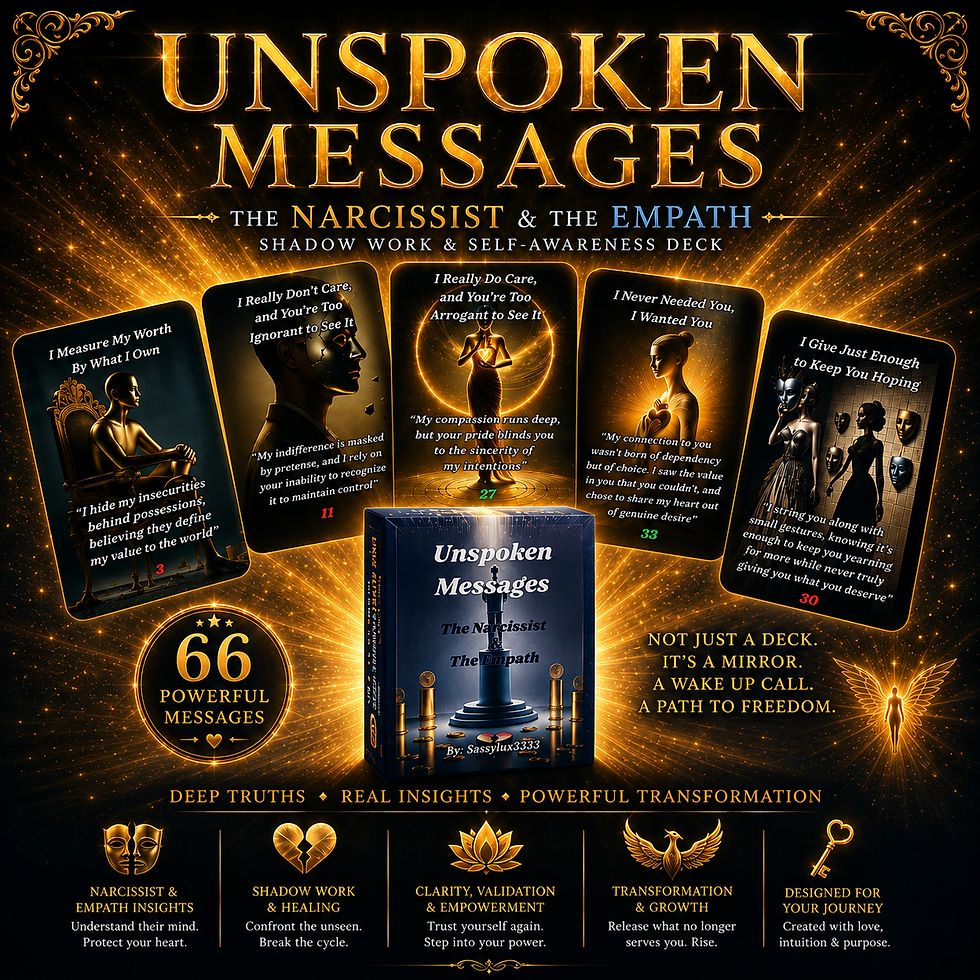
Unspoken Messages — The Narcissist and the Empath: A shadow work oracle deck focused on unhealthy relationship dynamics, manipulation, emotional patterns, boundaries, and the complicated interactions that can develop between narcissistic and empathic energies.
Pick Your Poison Oracle: A shadow work oracle deck centered around choices, opposing paths, consequences, and the uncomfortable truths that can surface when neither option feels entirely simple.

Each deck offers a different lens for looking beneath the trigger - whether the deeper question involves the person involved, the relationship dynamic, or the choices being made within it.
The Trigger Is Information, Not the Answer
An emotional trigger tells us that something has been activated. It does not automatically tell us why. It does not prove that another person is wrong. And it does not prove that we are.
Sometimes a trigger leads backward, toward an experience that still needs attention. Sometimes it leads directly to a problem occurring in the present. Sometimes it reveals an unmet need, an unhealthy pattern, or a boundary we have been afraid to establish.
The value lies in becoming willing to investigate rather than immediately react.
The question is not simply: "Why did this trigger me?"
Sometimes the more revealing question is: "What is this reaction asking me to see that I haven't seen clearly before?"
A trigger may begin with someone else, but what it reveals can become an opportunity to understand yourself more clearly. The lesson is not always to stay, forgive, leave, or change - it may simply be to see what was hidden before and choose what happens next with greater awareness.
Sometimes the trigger isn't the lesson. What you recognize because of it is.


Comments